The right scrub fit depends on more than the size printed on the label. Inseam, rise, waistband construction, thigh room, and leg shape can all change how scrub pants feel during a healthcare shift. When comparing women’s scrub pants, professionals should first identify the correct length category, then evaluate the pant silhouette and movement needs of their role.
Petite, regular, and tall describe length or proportion options, while jogger, tapered, straight-leg, and flare describe pant shape. Understanding the difference makes it easier to choose scrubs that fit properly without using a larger or smaller overall size to solve an inseam problem.
Quick Answer
Choose scrub pants by separating size, length, and leg style into three different decisions.
- Size addresses the waist, hip, and general garment dimensions.
- Length usually refers to petite, short, regular, or tall inseam options.
- Style describes the shape of the leg, such as jogger, tapered, straight, or flare.
Petite pants are generally intended for shorter proportions or inseams. Tall styles add length for longer legs. Regular is the standard length offered by a collection. Joggers taper to a fitted cuff, while straight-leg pants maintain a more consistent leg width.
Always review the specific size chart for the garment because measurements and proportions can differ between brands and collections.
Why does scrub pant fit matter during healthcare work?
Healthcare work can involve standing, walking, reaching, bending, and other repeated physical activities. NIOSH identifies awkward postures and the intensity, frequency, and duration of physical activity among workplace factors associated with work-related musculoskeletal concerns.
This does not mean that a particular pair of scrub pants prevents workplace injuries. It does mean work clothing should be evaluated in the context of normal job movement.
The NIOSH ergonomics guidance focuses on adapting work conditions to reduce discomfort and injury risks. OSHA similarly describes ergonomics as fitting work to the person and notes its role in reducing muscle fatigue and work-related musculoskeletal disorders.
For scrub pants, a practical fit should not repeatedly require the wearer to:
- Pull up the waistband
- Reposition the rise
- Adjust a slipping drawstring
- Step on an excessively long hem
- Pull fabric away from the knees before bending
- Straighten a twisting pant leg
- Reorganize overloaded pockets because the garment sags
A fit problem that seems minor while standing still can become more noticeable after several hours of movement.
What is the difference between scrub size and scrub length?
One of the most common scrub fit mistakes is trying to solve a length problem by changing the overall garment size.
Someone who needs a longer inseam may choose a larger regular-length pant. This might provide slightly more overall fabric, but it can also add unwanted room at the waist, hip, or thigh.
The opposite can happen when a wearer needs a shorter inseam. Sizing down may shorten the garment slightly, but it can also make the waistband or hip area too restrictive.
Size controls overall garment fit
Depending on the manufacturer’s sizing system, overall pant size primarily affects measurements such as:
- Waist
- Hip
- Seat
- Thigh
- Rise or general garment proportion
The exact grading pattern varies by garment.
Length addresses the inseam and proportion
Length categories may include:
- Petite
- Short
- Regular
- Tall
Not every manufacturer uses every term, and the exact inseam measurement should always be verified on the relevant size chart.
The important principle is simple:
Do not automatically change your scrub size when the actual problem is pant length.
How should scrub pants fit at the waist?
The waistband should remain secure during normal movement without creating unnecessary pressure.
A useful fitting test includes standing, sitting, bending, and walking.
While performing these movements, ask:
- Does the waistband stay in position?
- Does it roll or fold?
- Does the back of the pant pull downward when sitting?
- Is there excessive gaping at the waist?
- Does the drawstring need to be tightened significantly?
- Does the waistband feel restrictive after sitting?
A waistband that fits while standing may feel different once the hips and torso change position.
Elastic waistbands
Full elastic waistbands provide continuous stretch around the waist.
They can be convenient for workers who prefer simple pull-on pants, but the strength and width of the elastic can affect comfort.
Drawstring waistbands
Drawstrings allow the wearer to adjust the waistband.
The pant should still fit reasonably well before the drawstring is pulled extremely tight. A heavily cinched waist may indicate that the size or cut is not ideal.
Yoga-style waistbands
Wide knit waistbands are designed to create a broader contact area around the waist.
Some wearers prefer the smooth feel of this construction, especially when moving or sitting frequently.
Combination waistbands
Many scrub pants combine elastic with a drawstring.
This can provide both stretch and adjustability.
The best option depends on individual comfort, waist-to-hip proportions, and normal work movement.
What is scrub pant rise?
Rise describes the relationship between the crotch seam and waistband and affects where the pant sits on the torso.
Common terms include:
- Low rise
- Mid rise
- Natural rise
- High rise
Scrub collections do not always define these terms identically.
Why rise affects comfort
A rise that is too short may create pulling through the crotch or cause the waistband to shift downward when the wearer sits or bends.
An excessively long rise may create extra fabric or an unwanted low-hanging fit.
The correct rise should allow the wearer to:
- Sit comfortably
- Walk normally
- Bend without significant pulling
- Maintain appropriate coverage
- Keep the waistband in the preferred position
Rise is particularly important for professionals who spend parts of a shift alternating between standing and seated work.
What are petite scrub pants?
Petite scrub pants are generally designed for wearers who need shorter garment proportions or a shorter inseam.
They are especially useful when regular-length pants create excessive fabric near the ankle or floor.
Professionals exploring petite scrub pants should compare the actual size and inseam information for the specific style rather than assuming every petite pant has identical measurements.
Signs regular scrub pants may be too long
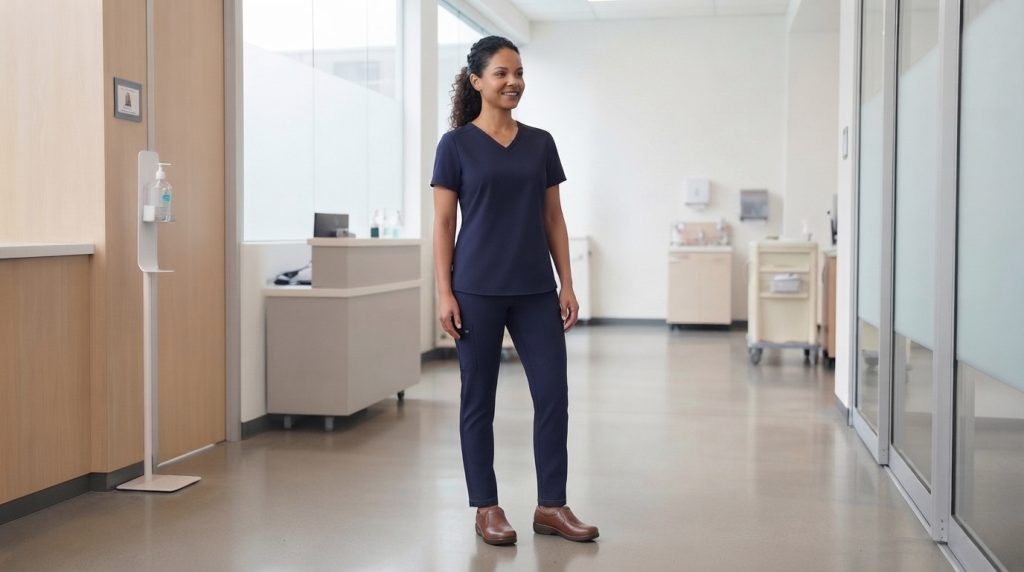
A petite option may be worth considering when:
- The hem drags near the floor
- Straight-leg pants bunch heavily over the shoe
- A tapered leg loses its intended shape
- Jogger cuffs sit too low
- The knee area appears misplaced
- Excess fabric repeatedly gathers at the ankle
The appearance of the pant is only part of the issue. Excess length can also become annoying during repeated walking.
Petite does not automatically mean a smaller size
This distinction is important.
A wearer may need the same waist and hip size in both regular and petite pants. The main difference required may be length or vertical proportion.
For example, someone who wears a medium regular pant but finds the inseam excessive may need a medium petite rather than a small regular.
Who should consider regular-length scrub pants?
Regular-length scrub pants are the standard proportion offered within many collections.
They can work well when:
- The hem sits correctly with work shoes
- The knee area aligns naturally
- There is no significant ankle bunching
- The pant does not appear cropped unintentionally
- The rise and leg proportions feel balanced
Regular should not be viewed as the “correct” length for everyone. It is simply one length category.
The wearer’s body proportions and the pant’s intended silhouette determine whether regular length is appropriate.
What are tall scrub pants?
Tall-length scrub pants are designed to provide additional length for wearers with longer inseam needs.
A dedicated tall option is often more appropriate than increasing the overall pant size just to gain extra fabric.
When reviewing tall scrub pants, check the stated inseam and the shape of the pant leg because a tall jogger and tall flare pant may need to sit differently at the ankle or shoe.
Signs regular pants may be too short
Consider a tall length when:
- Straight-leg pants appear unintentionally cropped
- The hem sits significantly higher than intended
- Flare or bootcut pants do not fall correctly over work shoes
- The knee shaping sits too high
- The pant pulls upward noticeably during normal movement
- A longer inseam is consistently needed in other work pants
Height can be a useful starting point, but it is not the only factor.
People of the same height can have different torso-to-leg proportions. Measuring inseam is more reliable than relying on height alone.
How do you measure inseam for scrub pants?
Inseam is measured from the crotch seam down the inside of the leg to the intended pant hem.
A practical way to estimate the preferred scrub inseam is to measure a pair of pants that already fits well.
Simple inseam measurement method
- Choose pants with a similar leg style.
- Lay the pants flat.
- Smooth the inside leg without stretching the fabric.
- Measure from the crotch seam to the bottom of the leg.
- Compare that measurement with the scrub size chart.
Use a similar pant silhouette when possible.
A well-fitting jogger may not provide the ideal reference measurement for a flare pant because the intended hem position is different.
Consider work shoes
Measure and evaluate scrub length with the type of footwear normally worn at work.
A straight-leg or flare pant can appear to have an acceptable length when barefoot but sit differently once work shoes are added.
Joggers are less dependent on shoe coverage because the cuff is intended to finish around the ankle.
What are jogger scrub pants?
Jogger scrub pants use a tapered lower leg and a fitted or elasticized ankle cuff.
They create a more athletic silhouette than traditional straight-leg scrub pants.

Why healthcare professionals choose joggers
Common reasons include:
- Less loose fabric around the ankle
- A modern tapered appearance
- Easy pairing with athletic-style work shoes
- A cuff that helps maintain the intended pant position
- Preference for a closer lower-leg fit
Joggers can be particularly practical for professionals who dislike wide pant hems.
However, fit should still be evaluated through the thigh, knee, calf, and ankle.
How should scrub joggers fit?
A jogger should generally allow normal bending and walking without excessive pulling across the knee or thigh.
Check whether:
- The cuff is comfortable
- The calf is not excessively tight
- The knee bends freely
- The waistband remains secure
- The rise provides adequate movement
- The pockets remain usable when filled
Joggers should not be selected solely because they are fashionable. The cut should still match the wearer’s body proportions and job activities.
What are straight-leg scrub pants?
Straight-leg pants maintain a relatively consistent silhouette from the thigh or knee toward the lower leg.
They provide a traditional scrub appearance and generally offer more lower-leg room than joggers.
Straight-leg scrub pants may suit workers who:
- Prefer a classic uniform style
- Dislike ankle cuffs
- Want more room around the calf
- Wear footwear that works well with a traditional hem
- Prefer fabric to fall naturally over the shoe
The hem length is important. Excessively long straight-leg pants may bunch or drag, while pants that are too short can appear unintentionally cropped.
What is the difference between tapered and jogger scrubs?
Tapered pants and joggers both narrow toward the ankle, but they are not identical.
Tapered scrub pants
A tapered pant gradually becomes narrower through the lower leg.
The hem usually remains open rather than using a fitted cuff.
Jogger scrub pants
A jogger also narrows through the leg but typically finishes with a cuff at the ankle.
The cuff creates a more defined stopping point.
For someone who likes a streamlined silhouette but does not want an elastic ankle, a tapered pant may be the better fit.
Are flare and bootcut scrub pants still practical?
Flare and bootcut scrub pants remain useful options for professionals who prefer additional width below the knee.
The distinction between the two can vary by manufacturer, but both generally create a wider lower-leg silhouette than tapered or straight styles.
These styles require careful length selection.
If the pant is too long, the wider hem may contact the floor. If it is too short, the intended proportion of the flare may look uneven.
Fit should be tested with normal work footwear.
How should scrub pants fit through the hips and thighs?
Scrub pants should allow normal movement without significant pulling or excessive loose fabric.
Signs the pant may be too tight
Look for:
- Strong horizontal pulling lines
- Pockets that remain open or flare outward
- Restriction when sitting
- Tightness during bending
- Fabric pulling heavily across the upper thigh
- A waistband that shifts because the hip area is restrictive
Signs the pant may be too loose
Possible indicators include:
- Repeated waistband adjustment
- Excessive fabric through the seat
- Pockets sagging before items are added
- The crotch sitting significantly lower than intended
- Pant legs twisting because the garment shifts
- A drawstring requiring extreme tightening
The goal is not to achieve the closest possible fit.
Healthcare duties can involve substantial movement. NIOSH’s healthcare guidance notes that patient handling can involve tasks requiring workers to move and handle patients, while assistive technologies and safe patient handling practices are used to address related risks.
The NIOSH safe patient handling and mobility guidance is a useful reminder that healthcare movement demands should be considered in the broader work environment. Scrub fit should not be described as a substitute for ergonomic practices, equipment, or workplace safety procedures.
Do pocket styles affect scrub pant fit?
Yes. Pocket position and pocket load can change how pants feel during a shift.
Common scrub pant pockets include:
- Front slash pockets
- Patch pockets
- Cargo pockets
- Back pockets
- Zippered pockets
- Smaller accessory compartments
Cargo pockets
Cargo pockets provide storage along the thigh.
They can be useful for approved work items, but filling one side with heavier objects may cause the pant leg or waistband to pull unevenly.
Front pockets
Front pockets provide easy access, but large items can affect comfort while sitting.
Back pockets
Back pockets may suit lightweight items but can become uncomfortable when sitting for extended periods.
Before choosing pants based on pocket count, think about the actual items carried during a normal shift.
A six-pocket pant is not automatically more practical than a three-pocket pant if several pockets are never used.
How does fabric stretch affect scrub fit?
Stretch can make a fitted scrub style feel more flexible, but it does not correct an incorrect size or inseam.
A stretch fabric may provide more movement through the knees and hips. However, if the waistband is too large, the pants can still slip. If the inseam is too long, the hem can still gather.
Fit and fabric should be evaluated together.
Four-way stretch does not mean one size fits everyone
Stretch terminology describes fabric behavior, not universal sizing.
Always review the specific garment measurements and test normal movement.
Structured fabrics may fit differently
A more structured fabric may maintain its shape differently from a soft, highly flexible material.
Two pants with similar measurements can therefore feel different when worn.
Consider:
- Fabric weight
- Stretch
- Drape
- Waistband construction
- Leg cut
The entire garment design affects fit.
Which scrub pant fit is best for long shifts?
There is no single best pant silhouette for every long healthcare shift.
A better question is:
Which fit requires the least unnecessary adjustment during the wearer’s normal workday?
For one professional, that may be a mid-rise jogger with a full elastic waistband. Another may prefer a straight-leg pant with a drawstring. Someone with a shorter inseam may experience a major improvement simply by switching from regular to petite length.
Prioritize:
- Secure waistband fit
- Correct inseam
- Comfortable rise
- Sufficient hip and thigh room
- Knee mobility
- Practical pockets
- Appropriate workplace appearance
Personal preference becomes more useful after these basic fit requirements are met.
A simple scrub fit test before choosing pants
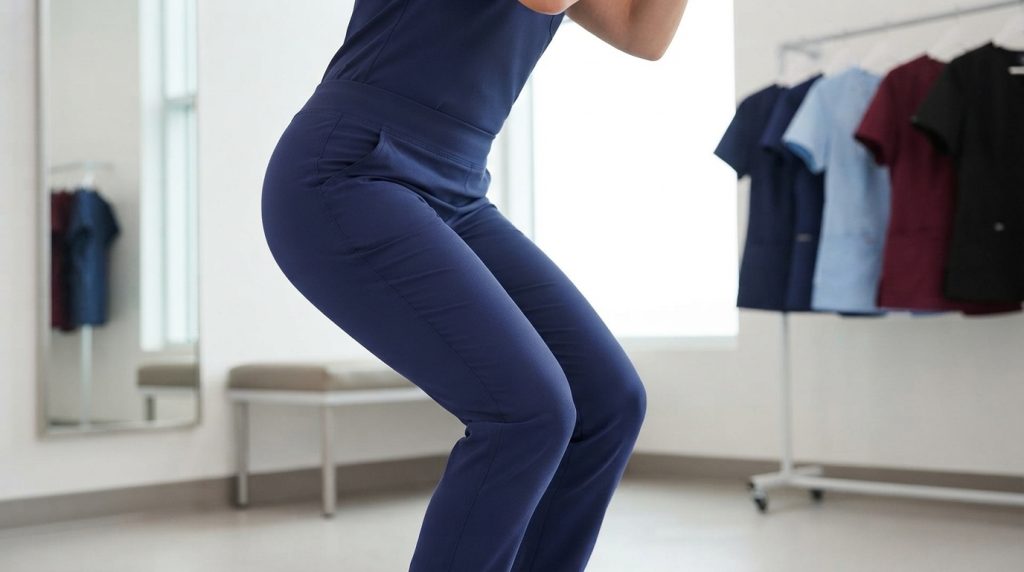
Use this movement check when trying on scrub pants:
1. Stand normally
Check the waistband, hip, thigh, and overall leg shape.
2. Walk several steps
Notice whether the waistband slips or the pant legs twist.
3. Sit in a chair
Check waistband pressure and back coverage.
4. Bend at the knees
Observe whether the fabric pulls excessively across the thighs or knees.
5. Reach toward a low surface
Check whether the waistband changes position.
6. Use the pockets
Place typical lightweight work items in the intended pockets and assess balance.
7. Check the hem with work shoes
Make sure the pant length suits the silhouette.
This is not a medical or ergonomic assessment. It is simply a practical clothing fit check designed to identify obvious garment problems before repeated work use.
Professionals who prefer to inspect different lengths and silhouettes in person can also visit a medical uniform store in Wilmington to compare how scrub fits change across styles.
Common scrub fit mistakes to avoid
Choosing by height alone
Height does not fully explain leg proportion or inseam.
Measure a well-fitting pair of pants when possible.
Sizing up to get more length
A larger size may add unwanted room throughout the garment.
Look for a tall or longer-length option first.
Sizing down to shorten the pant
This can make the hip, thigh, or waistband unnecessarily tight.
Consider petite or short lengths.
Assuming every brand uses the same inseam
Check the specific size chart and product details.
Ignoring rise
Waist size can be correct while the pant still feels uncomfortable because the rise does not suit the wearer.
Evaluating pants only while standing
Healthcare work involves movement. Sit, bend, and walk before judging the fit.
Buying a jogger without checking calf room
A comfortable thigh does not guarantee the lower leg will fit correctly.
Overlooking footwear
Pant length and shoe style work together, especially with straight, bootcut, and flare silhouettes.
How to choose between petite, regular, tall, jogger and straight-leg scrubs
Follow this order:
- Determine the correct overall size. Focus on waist and hip fit.
- Identify the required inseam. Compare petite, short, regular, or tall options.
- Choose the preferred rise. Consider where the waistband sits during movement.
- Select a leg silhouette. Compare jogger, tapered, straight, bootcut, or flare.
- Check thigh and knee mobility. Sit and bend naturally.
- Review the waistband. Test elastic, drawstring, yoga, or combination styles.
- Evaluate pockets. Match storage to actual work needs.
- Wear normal work shoes. Check the finished pant length.
- Review the size chart. Do not assume sizing is identical across collections.
- Choose the fit that needs the least adjustment. Comfort should remain practical during movement.
Final Thoughts
Scrub fit becomes easier to understand when size, length, and pant style are treated as separate decisions.
Petite, regular, and tall options address length and proportion. Jogger, tapered, straight-leg, and flare styles address the shape of the pant. Waistband and rise affect how the garment sits on the torso, while fabric and pocket placement influence the overall wearing experience.
The correct fit is not necessarily the loosest or most fitted option. It is the scrub pant that stays appropriately positioned, provides sufficient movement, works with normal footwear, and matches workplace requirements.
Measure the inseam, review the size chart, and test realistic movement before deciding. A small change in length or silhouette can often solve a fit problem more effectively than changing the overall garment size.
Frequently Asked Questions
What is the difference between petite and regular scrub pants?
Petite scrub pants are generally designed with a shorter inseam or shorter garment proportions than regular-length pants. Exact measurements vary by style and manufacturer. A wearer may use the same overall size in petite and regular pants but choose petite when regular pants are too long.
How do I know if I need tall scrub pants?
Tall scrub pants may be appropriate when regular-length styles consistently sit higher than intended, the knee shaping appears too high, or a longer inseam is normally required. Measure a well-fitting pair of pants and compare the inseam with the specific scrub size chart.
Should scrub pants be tight or loose?
Scrub pants should provide enough room for normal walking, sitting, bending, and other work movement without repeatedly slipping or creating excessive loose fabric. The correct fit depends on body proportions, fabric, rise, and pant style rather than choosing the tightest or loosest option.
Are jogger scrubs better than straight-leg scrubs?
Neither style is universally better. Joggers provide a tapered lower leg and fitted ankle cuff, while straight-leg pants offer a more traditional silhouette with additional lower-leg room. The better choice depends on fit preference, calf room, footwear, workplace expectations, and movement needs.
Can I size up instead of buying tall scrub pants?
Sizing up may add some overall garment length, but it can also add unnecessary room through the waist, hip, and thigh. When the main problem is inseam length, a dedicated tall option is usually more directly aligned with the fit issue.