
A hit-and-run accident in Phoenix creates a race against time. The other driver may be gone, but the evidence may still be nearby: a partial license plate, a witness, dashcam footage, paint transfer, a business camera, a parking-lot video, a rideshare receipt, or a police report number.
The problem is that many of those clues can disappear quickly. Memory fades. Vehicles get repaired. Camera footage may be overwritten. Witnesses leave the area. Medical symptoms may become harder to connect to the crash if care is delayed.
This guide explains how to protect yourself after a Phoenix hit-and-run accident, what evidence to save first, how insurance may apply, and when legal guidance may be useful.
Quick Answer
After a hit-and-run accident in Phoenix, do not chase the fleeing driver. Move to safety, call 911, get medical care if needed, write down vehicle details immediately, photograph the scene, collect witness information, look for nearby cameras, track the police or crash report, notify your insurer, and save all medical, repair, rental, wage, and expense records.
If you were injured, the driver cannot be found, insurance coverage is unclear, or the insurer disputes the claim, speaking with a phoenix injury attorney may help you understand what evidence matters, what insurance options may apply, and what Arizona deadlines could affect your claim.
Key Takeaways
- A Phoenix hit-and-run claim often depends on evidence preserved in the first hours and days after the crash.
- Do not chase or confront the fleeing driver.
- Write down vehicle color, body style, full or partial plate, damage location, direction of travel, and distinctive features as soon as you are safe.
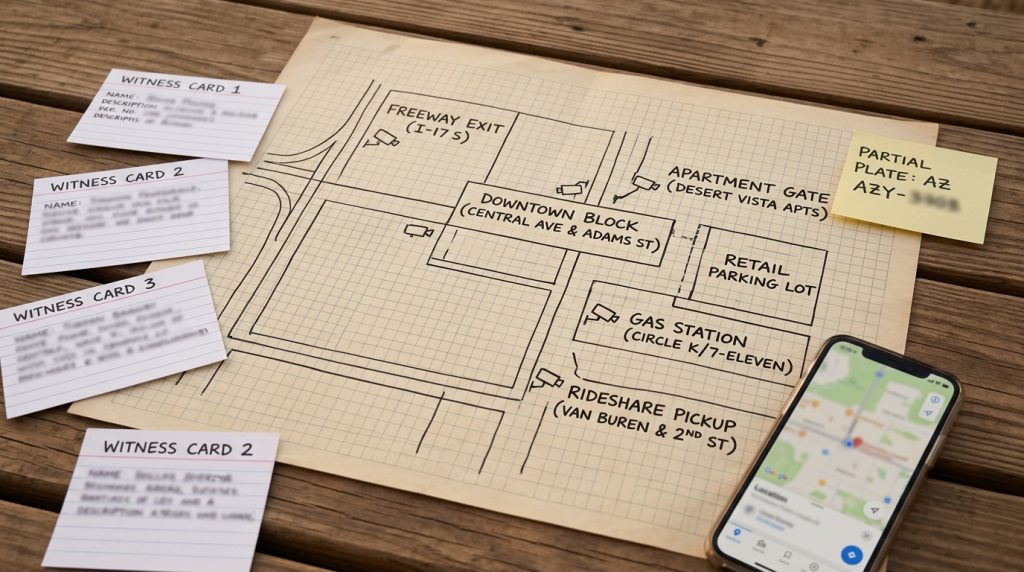
- Nearby cameras may include business cameras, apartment gate cameras, parking garage cameras, hotel cameras, dashcams, doorbell cameras, and gas station cameras.
- Your own insurance may become important if the driver is never found or lacks coverage.
- Arizona law includes stop-and-assist duties, injury deadlines, public-entity notice rules, and comparative-negligence rules that may affect a claim.
The Vanishing Driver Evidence Clock
A hit-and-run claim is different because the first source of information has left the scene. You may not have a name, insurance card, driver’s license, complete plate, or explanation.
That makes timing critical.
Think of the claim in four evidence windows:
The First 10 Minutes: Memory Details
Write down everything you remember before stress, pain, and traffic noise blur the details.
Capture:
- Vehicle color
- Vehicle make or model, if known
- Body style, such as sedan, SUV, pickup, van, motorcycle, or commercial vehicle
- Full or partial license plate
- Plate state, if visible
- Direction the driver traveled
- Damage location on the fleeing vehicle
- Distinctive features, such as stickers, decals, tinted windows, missing lights, cargo, lifted suspension, or company markings
- Driver or passenger description, if visible
- Time of crash
- Exact location
- Lane position
- Traffic conditions
- Weather and lighting
A partial plate combined with vehicle color, body style, and direction of travel may be more useful than one detail alone.
The First Hour: Scene Evidence
If it is safe, photograph:
- Vehicle damage
- Paint transfer
- Broken glass
- Debris
- Road layout
- Traffic signals
- Signs
- Skid or tire marks
- Final vehicle position
- Nearby cameras
- Weather and lighting
- Visible injuries
- Damaged personal property
Do not wash off paint transfer, repair the vehicle, or throw away broken parts before documenting them.
The First Day: Reports and Cameras
Call police and ask how to track the report number. If the crash happened near a business, apartment complex, hotel, restaurant, gas station, parking garage, office building, or retail center, ask about camera footage quickly.
Possible camera sources include:
- Dashcams
- Doorbell cameras
- Storefront cameras
- Apartment gate cameras
- Hotel cameras
- Restaurant cameras
- Parking garage cameras
- Gas station cameras
- Office building cameras
- Traffic-adjacent business cameras
- Rideshare or delivery vehicle cameras
The First Week: Medical and Insurance Records
Get medical care and begin organizing insurance records. A delayed medical timeline can create disputes later, especially if symptoms worsen over time.
Save:
- Emergency room records
- Urgent care records
- Doctor notes
- Imaging reports
- Specialist referrals
- Physical therapy records
- Prescription receipts
- Medical bills
- Work restriction notes
- Insurance claim numbers
- Adjuster contact information
- Repair estimates
- Rental receipts
- Wage-loss records
Why Phoenix Hit-And-Run Claims Can Be Complicated
Phoenix is a large desert metro area with wide arterials, high-speed corridors, freeway traffic, long commutes, rideshare activity, delivery vehicles, apartment communities, shopping centers, and parking-lot traffic.
Hit-and-run crashes may happen on or near:
- I-10
- I-17
- Loop 101
- Loop 202
- SR 51
- US 60
- Grand Avenue
- Camelback Road
- Indian School Road
- Bell Road
- McDowell Road
- Van Buren Street
- Downtown Phoenix
- Roosevelt Row
- Midtown
- Arcadia
- Maryvale
- South Mountain
- Desert Ridge
- Biltmore
- Airport-adjacent roads
- Apartment entrances
- Retail parking lots
- Gas stations
- Hotel driveways
- Rideshare pickup zones
The crash setting matters because it points to different evidence. A freeway hit-and-run may depend on exit direction, dashcam footage, and tow records. A downtown crash may involve business cameras and witnesses on foot. A parking-lot hit-and-run may depend on store video, paint transfer, and property incident reports.
What Arizona Law Says About Leaving a Crash Scene
Arizona law requires drivers involved in certain crashes to stop, remain at or return to the scene, and complete required information-and-assistance duties.
In injury or death crashes, Arizona Revised Statutes Section 28-661 requires the driver to stop and remain at the scene until the duties in Section 28-663 are fulfilled. In crashes involving damage to an attended vehicle, Section 28-662 requires the driver to stop at or near the scene and remain until the duties in Section 28-663 are fulfilled. Section 28-663 addresses giving driver and vehicle information and rendering reasonable assistance when needed.
For an injured person, the civil claim questions are practical:
- Can the driver be identified?
- Is there insurance coverage?
- What evidence supports what happened?
- What medical records connect the injuries to the crash?
- Does your own insurance policy provide coverage?
- What Arizona deadlines apply?
The other driver’s decision to leave may be important, but your claim still needs proof.
Do Not Chase the Fleeing Driver
It may feel natural to follow the vehicle to get the plate number. Do not chase the driver.
Chasing can:
- Cause a second crash
- Make injuries worse
- Endanger passengers
- Create a confrontation
- Put pedestrians or cyclists at risk
- Pull you away from the original scene
- Make it harder to preserve evidence
- Create confusion about what happened
Instead, move to a safe location, call 911, and write down what you remember.
Reporting the Crash and Tracking Records
A police report can help document that the crash was reported promptly. It may also record driver information, vehicle descriptions, witness details, location, injuries, statements, and responding officer information.
For Phoenix-related police records, the City of Phoenix Public Records portal provides access to public safety record-request services. The Arizona Department of Transportation also provides Arizona crash report resources, and the Arizona Department of Public Safety processes DPS-related records requests, including collision and accident reports.
When reporting or tracking the crash, save:
- Report number
- Responding agency
- Officer name, if known
- Crash date
- Crash time
- Crash location
- Vehicle description
- Direction of travel
- Witness names
- Insurance claim number
- Any camera-source notes
If the crash was minor and investigated through a different process, follow the instructions from the responding agency or insurer.
Camera Sweep: Where to Look Before Footage Is Gone
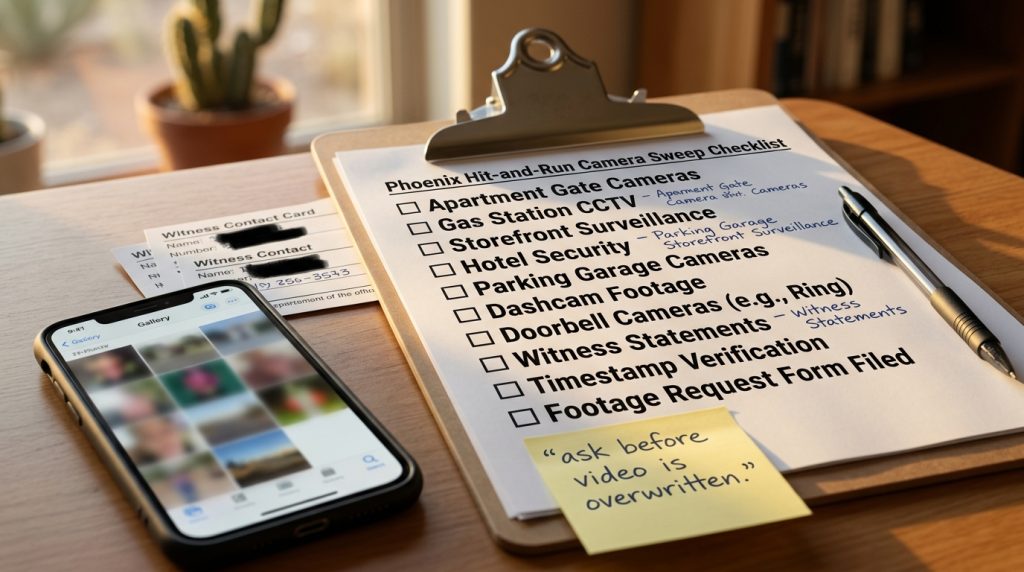
Camera footage may be the most important evidence in a Phoenix hit-and-run claim.
Look around the scene for:
- Apartment gate cameras
- Business cameras facing the road
- Hotel entrance cameras
- Restaurant cameras
- Gas station cameras
- Parking garage cameras
- Retail store cameras
- Office building cameras
- Doorbell cameras
- Dashcams from nearby cars
- Rideshare vehicle cameras
- Delivery vehicle cameras
Write down the names and addresses of nearby businesses, apartment complexes, and buildings. If you speak with someone, write down their name, role, date, and what they said about footage.
Camera systems may overwrite footage. Ask early.
Medical Care Matters Even When the Driver Is Unknown
Some people delay care because they do not know who will pay. That delay can hurt both health and documentation.
Seek medical attention for:
- Headaches
- Dizziness
- Confusion
- Neck pain
- Back pain
- Shoulder pain
- Knee pain
- Chest pain
- Abdominal pain
- Numbness or tingling
- Trouble sleeping
- Anxiety after the crash
- Symptoms that appear or worsen later
Save records from:
- Emergency medical services
- Emergency rooms
- Urgent care clinics
- Primary care doctors
- Orthopedic specialists
- Neurologists
- Imaging centers
- Physical therapy providers
- Pharmacies
A clear medical timeline can help show when symptoms began, what injuries were diagnosed, and what treatment was recommended.
Insurance Options After a Phoenix Hit-And-Run
If the hit-and-run driver is not found, your own insurance may become important.
Possible coverage sources may include:
- Collision coverage
- Uninsured motorist coverage
- Underinsured motorist coverage
- Medical payments coverage
- Rental reimbursement coverage
- Health insurance
- Rideshare or commercial coverage, depending on the facts
The Arizona Department of Insurance and Financial Institutions describes uninsured motorist coverage as protection for bodily injuries sustained in an accident involving a driver who has no liability coverage. Arizona law also defines uninsured and underinsured motorist coverage in Arizona Revised Statutes Section 20-259.01.
Coverage can depend on the policy language, reporting requirements, available evidence, and whether the insurer accepts that another vehicle caused the crash.
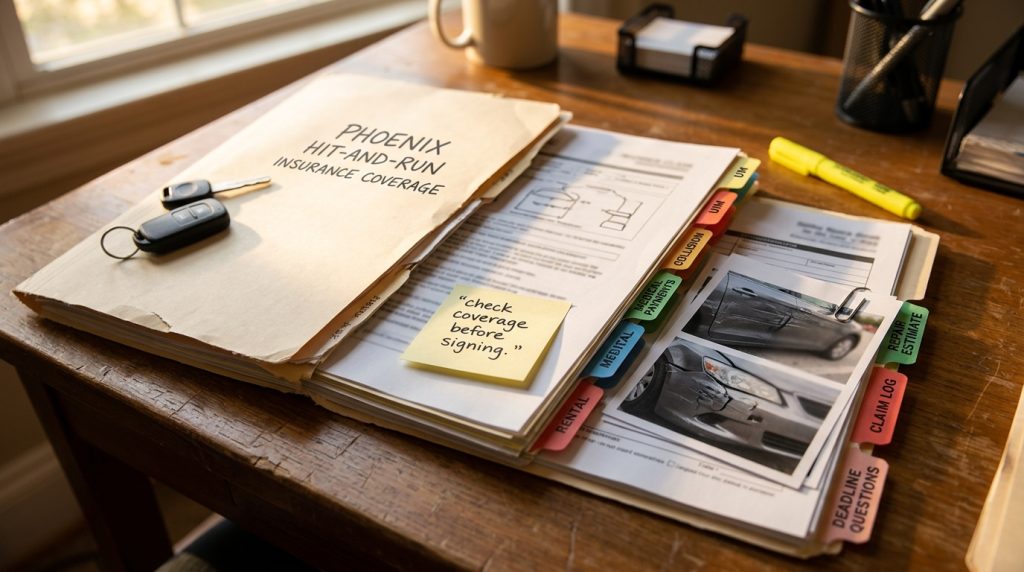
Do not assume coverage applies automatically. Review the policy and save every insurance communication.
What If the Driver Is Found Later?
If the driver is identified, the claim may shift toward the driver, vehicle owner, and available insurance coverage.
Evidence may include:
- Police report
- Driver identity
- Vehicle registration
- Insurance information
- Witness statements
- Camera footage
- Vehicle damage comparison
- Paint transfer evidence
- Repair records
- Criminal case information, when relevant
Finding the driver does not always make the claim simple. The driver may deny fault, claim someone else was driving, lack insurance, have limited coverage, or dispute the injuries.
Your own insurance may still matter.
What If the Driver Is Never Found?
If the driver remains unidentified, your claim may depend heavily on your own coverage and supporting evidence.
Important questions may include:
- Was the crash reported promptly?
- Was insurance notified promptly?
- Do you have uninsured motorist coverage?
- Do you have collision coverage?
- Do you have medical payments coverage?
- Do you have rental reimbursement coverage?
- Are there witnesses?
- Is there camera footage?
- Is the damage consistent with a hit-and-run?
- Did you seek medical care?
- Did you preserve repair and expense records?
Even without the other driver’s name, documentation can help support the claim.
Common Insurance Disputes After a Hit-And-Run
Hit-and-run claims can create insurance disputes.
Common issues include:
- The insurer questions whether another vehicle caused the damage
- The insurer asks for a recorded statement
- The insurer says a police report is missing
- The insurer disputes the injury timeline
- The insurer disputes treatment gaps
- The insurer says coverage does not apply
- The insurer offers less than the repair estimate
- The insurer disputes rental costs
- The insurer questions lost wage records
- The insurer requests broad medical authorizations
- The insurer delays while waiting for investigation updates
A well-organized file can help answer these disputes with records instead of memory.
Phoenix Road Safety Context
The City of Phoenix Road Safety Action Plan includes a data-evaluation method and a High Injury Network used to identify problem locations and prioritize safety solutions. That local safety context does not prove a specific hit-and-run claim, but it shows why crash location, road layout, speed, lighting, visibility, and vulnerable-road-user details can matter.
After a hit-and-run, write down:
- Road name and cross street
- Direction of travel
- Lane position
- Nearby businesses
- Nearby apartments or parking garages
- Camera locations
- Crosswalks or signals
- Lighting conditions
- Construction or road hazards
- Weather
- Traffic conditions
- Whether pedestrians, cyclists, scooters, delivery vehicles, or rideshare vehicles were involved
Location details can become important if fault, visibility, or vehicle movement is disputed.
Arizona Deadlines and Fault Issues
Arizona personal injury claims are time-sensitive. In many cases, actions for injuries to a person must be commenced and prosecuted within two years after the cause of action accrues under Arizona Revised Statutes Section 12-542.
Some cases may involve shorter notice requirements. For example, certain claims against a public entity, public school, or public employee require a notice of claim within 180 days after the cause of action accrues under Arizona Revised Statutes Section 12-821.01.
Arizona law can also affect cases when fault is disputed. Under Arizona Revised Statutes Section 12-2505, comparative negligence may reduce damages according to the claimant’s degree of fault.
Even in a hit-and-run case, an insurer may argue that the injured person was partly responsible, delayed medical care, or gave inconsistent statements. Evidence is especially important when responsibility is disputed.
When Legal Guidance May Be Useful
Not every hit-and-run claim requires legal help. But legal guidance may be useful when the crash involves injury, unclear coverage, missing evidence, disputed fault, or insurance delays.
Consider speaking with a lawyer if:
- You were injured
- You needed emergency care
- Medical treatment is ongoing
- The driver has not been found
- The driver was found but has no insurance
- Your insurer disputes coverage
- Your insurer delays or denies the claim
- Fault is disputed
- The crash involved a pedestrian, cyclist, motorcyclist, or child
- The crash involved a rideshare or delivery vehicle
- You missed work
- The settlement offer seems too low
- A public vehicle, roadway condition, or government employee may be involved
- A loved one suffered a fatal injury
A lawyer may help preserve evidence, request records, identify insurance coverage, communicate with adjusters, evaluate damages, and explain Arizona deadlines.
Mistakes to Avoid After a Phoenix Hit-And-Run
Avoid these common mistakes:
- Chasing the fleeing driver
- Leaving without reporting the crash
- Waiting too long to call police
- Failing to seek medical care
- Not writing down vehicle details immediately
- Forgetting to look for witnesses
- Waiting too long to ask about camera footage
- Repairing the vehicle before taking photos
- Washing off paint transfer
- Throwing away damaged parts
- Giving broad recorded statements
- Guessing about facts you do not know
- Posting crash details on social media
- Accepting a quick settlement before treatment is complete
- Missing insurance notice or documentation requirements
- Waiting too long to ask about deadlines
Small mistakes can make a hit-and-run claim harder to prove.
Phoenix Hit-And-Run Evidence Clock Checklist
Use this checklist to organize the claim:
Immediately
- Move to safety
- Do not chase the fleeing driver
- Call 911
- Check for injuries
- Write down vehicle details
- Note direction of travel
- Save full or partial plate information
At the Scene
- Take photos of damage, debris, road layout, and cameras
- Collect witness names and phone numbers
- Look for dashcams, businesses, apartments, and parking cameras
- Ask for the report number if police respond
Within the First Day
- Seek medical care
- Notify insurance
- Save claim number and adjuster contact information
- Request or track police records
- Ask nearby businesses about footage
During the Claim
- Save medical records and bills
- Keep repair estimates and rental receipts
- Track missed work and out-of-pocket costs
- Avoid broad recorded statements
- Review insurance coverage before signing
- Ask about Arizona deadlines early
FAQ
Move to safety, call 911, seek medical care if needed, write down everything you remember about the fleeing vehicle, photograph the scene, collect witness information, look for nearby cameras, and notify your insurer.
No. Chasing a fleeing driver can cause another crash or confrontation. It is safer to preserve vehicle details, call police, and stay at or near the original scene if possible.
Write down vehicle color, make, model, body style, full or partial plate, plate state, visible damage, direction of travel, driver description, and distinctive features such as decals, cargo, missing lights, tinted windows, or company markings.
A police report can be important because it helps document that the crash was reported. Insurers may also request report information when reviewing coverage.
Look for dashcams, doorbell cameras, apartment gate cameras, business cameras, hotel cameras, gas station cameras, parking garage cameras, retail cameras, office building cameras, and rideshare or delivery vehicle cameras.
Possibly. Your own insurance may apply depending on your policy and the facts. Uninsured motorist coverage, collision coverage, medical payments coverage, rental reimbursement, or other benefits may become important.
Seek medical care and explain when the crash happened and when symptoms began. Delayed symptoms can happen, but documentation is important.
It may depend on your policy, the facts, and the available evidence. Review your policy and ask questions before assuming coverage does or does not apply.
In many Arizona injury cases, the general deadline is two years from when the cause of action accrues. Some claims, including certain public-entity claims, may involve shorter notice requirements.
No. This article is for general informational purposes only. Anyone dealing with a specific hit-and-run accident claim should speak with a qualified legal professional about their situation.
Final Thoughts
A Phoenix hit-and-run accident can feel like the other driver took the answers with them. But the evidence clock starts right away, and there may still be records that help explain what happened.
The most important steps are to stay safe, call police, write down details quickly, look for witnesses and cameras, get medical care, notify insurance, preserve records, and ask about Arizona deadlines before evidence disappears.